My memories of growing up in the fifties is pretty hazy, but I do remember with crystal clarity our painfully slow to warm up black and white Motorola television set, the syndicated series “The Adventures of Superman”, and the relationship between the two.
Before VCRs, Superman was appointment TV for the pre-teen set that swamped America in the baby boomer fifties. To the extent that eight-year-olds had a shared culture in my native Chicago, it was around watching the cheaply-produced half-hour series on superstation WGN-TV. As a Chicagoan, I waited for the moment that actor George Reeves as Superman was suspended by wires as he “flew” over Lincoln Village, just a few miles away from where I lived.
My parents always knew that no matter where we were, we had to get home a few minutes before six o’clock to warm up the Motorola in time to hear the “faster than a speeding bullet” intro. On those few occasions we were late, there was hell to pay from their only child.
So it was no surprise that when the 47-year-old Reeves took his own life, allegedly in frustration for his inability to secure quality acting roles after being typecast as the Man of Steel, a whole nation of kids mourned. We did so in much the same, belligerent way as private eye Louis Simo’s young son acts out when he hears about Reeves’ passing in Allen Coulter’s 2006 contemplation of the decades-old mystery around the actor’s death, the sadness-soaked “Hollywoodland”.
George Reeves was a second-tier actor who wandered the Hollywood demi-world in a series of supporting parts in forgettable movies, after his auspicious debut in 1939 in “Gone with the Wind” as one of the overeager Tarleton brothers who hits on Scarlett O’Hara (Vivien Leigh) in the movie’s first scene but is then seen no more. Which was a good analogy for Reeves’ unremarkable career when, despite his misgivings he donned the cape and tights for the first time.
Whatever he felt about the role that made him beloved by millions, the sense of dignity he imbued in a character that spends most of his time wearing tights and a cape clearly showed that the man had talent. He may have considered the super hero role beneath him but he never phoned it in. At least we adoring kids believed in him. To his credit, he returned the affection, despite his frustration at being typecast and his concern that he wouldn’t be taken seriously as an actor afterward. Reeves even gave up cigarettes because he didn’t want kids to see Superman smoking.
Reeves was generally considered a really good guy who appreciated a good joke, even at his own expense. His co-stars, Jack Larson (as eager beaver photographer Jimmy Olsen) and Noel Neill (as Lois Lane, perpetually exasperated with Superman’s alter ego, an intentionally milquetoast Clark Kent), were totally devoted to him. Ben Affleck as the doomed actor in “Hollywoodland” brings a sense of jocularity and ribaldry to his portrayal of Reeves, and by the end of the film you are totally invested in him. The boy was a charmer, as the older woman in his life, Toni Maddox (the eternally-watchable Diane Lane) might say, and Affleck delivers the goods.
A case in point is Affleck’s handling of an incident that actually happened during one of the many personal appearances Reeves made to promote the show and connect with his young fans. One of the kids gets a hold of a loaded gun, approaches the actor, and tells him he wants to shoot him to see the bullets bounce off, like on the TV show. You can see Affleck is clearly frightened, but at the same time struggling to stay in character and use his authority as Superman to convince the child (successfully after a hot minute that seems to go on forever) to give up the gun.
But the glue that holds the movie together is the top-billed Adrien Brody as Simo, a facsimile of a human being held together by coffee, his girl Friday (who doubles as his sometime girlfriend) and the hope that his next case will get him out of his cheap hotel and into the big time. It is through Simo’s search for the truth about Reeves’ untimely death that teaches him lessons about himself. He never “solves” the case but comes away with the resolve to clean himself up and hopefully become a worthy father to his estranged son.
The ending may feel too easily earned, but Brody sells it and he works hard enough at bringing Simo’s contradictions to life that we are willing to cut him some slack. Which may be more than his Hollywood contemporaries would do for a combustible, often brilliant actor who many thought had flown too close to the sun following his Oscar-winning performance in disgraced director Roman Polanski’s “The Pianist” (2003). The height of Brody’s audacity was his unscripted- and unsolicited- kissing of his astonished Oscar presenter, Hallie Berry.
It’s not that Brody hadn’t known disappointment on his way up the ladder to Oscar fame at age 29 as the youngest man ever to win the “Best Actor” academy award. In 1998, he was meant to be the lead in the ensemble cast Terrence Malik put together for his acclaimed World War Two epic, “The Thin Red Line”, only to have most of his role end up on the cutting room floor when Malik, watching the dailies, was smitten by one of Brody’s co-stars, the dark, soulful James Caviezel, who supplanted Brody as star, with the latter only discovering it when he sat down to watch the film’s premiere. Supposedly the humiliated actor felt a kinship with Reeves, who had much the same thing happen to him in 1953, when his role in the Academy-award winning “From Here to Eternity” was cut down to one disposable scene (the result of preview audiences yelling “there’s Superman” whenever Reeves appeared on screen, depicted in the 2006 film).
After “The Pianist”, Brody had only mixed success and was in what many would call an early career slump when he took on the role of Simo, an appropriately seedy, cynical and down on his luck private detective in late fifties Los Angeles who seems always to have a wad of gum in this mouth, to go with a mouthful of attitude. Simo takes on a case that he thinks can bring him notoriety and fortune, just as the actor, still only in his early thirties, might have thought the Simo role would jump start his suddenly faltering career.
“Hollywoodland” takes as its premise that the Reeves case is still after all these years a mystery; it proposes the possibility that Reeves was either murdered by a jealous and powerful Hollywood power broker or was the victim of a heated argument with his mercurial fiancé that ends in an accidental killing. It doesn’t help that reportedly the guests at Reeves’ home the night of his death acted suspiciously afterward, and the Los Angeles Police Department did less than a bang-up job of investigating, allowing vital fingerprints to be wiped clean and the body embalmed before a proper autopsy could be done.
In the film, Reeves’ grieving mother (legendary character actress Lois Smith) seeks answers. She tries to retain a major local detective firm but they won’t touch the case, worried about getting crosswise with the major studios and having their business go into the tank. One of the firm’s operatives on the QT throws the case as a bone to Simo, himself a former operative of the firm. The down and out detective’s strategy is to kick up some dust and by doing so keep the case in the public eye so he can milk as many dollars from the elderly Mrs. Reeves as possible while generating notoriety for himself.
As he delves further, though, a lot of ostensibly innocent people proceed to act like they’re hiding something, notably Toni’s husband, the feared Metro Goldwyn Mayer fixer Eddie Mannix (an appropriately menacing Bob Hoskins) and the fixer’s fixer, underplayed to smarmy perfection by “Hill Street Blues”’ Joe Spano. Simo begins to believe that Mannix had Reeves killed as retribution for his affair with his wife. The truth as presented in the film is much more prosaic—Mannix likely used his tremendous clout in a company town to make sure that Reeves never worked again, at least in anything meaningful. And not because of the affair; in fact for just the opposite reason— as revenge for Reeves having broken his wife’s heart by breaking off the affair in favor of a younger woman.
Brody’s best moments in the film are when he says nothing at all; it seems that director Coulter (of “The Sopranos” fame) understands the actor’s rare ability to hold the screen in moments of silence while communicating his thoughts to his audience almost through telepathy. There’s the scene late in the film in which Brody as Simo watches a “home movie” Reeves produced that was meant as his entree into action films. It’s as if Brody viewing the clip is looking through a window into the dead actor’s soul.
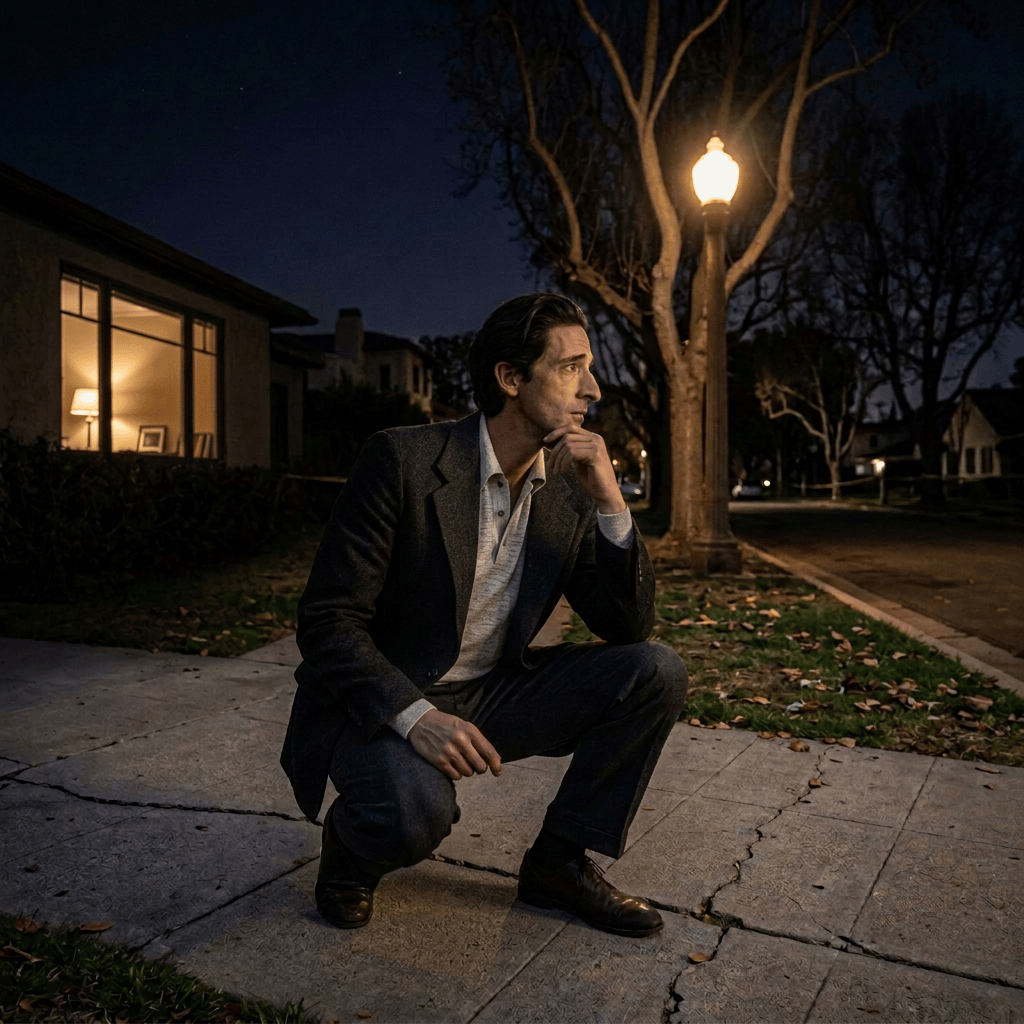
But the punctuation mark for Brody’s finely-tuned, melancholic performance is the climactic scene, brilliantly constructed, where Simo crouches in front of Reeves’ home, saying not a word, imagining three scenarios–one a suicide, another an accidental killing and the other a murder at the hands of his much younger fiancée (a go-for-broke performance by Robin Tunney as a streetwise Leonore Lemmon). A moment comes when Coulter’s camera plays a trick, suggesting that Simo and Reeves are staring at each other in real time, which seems to break the spell that the case has over Simo. It is the moment when Simo metaphorically looks into the dead actor’s eyes and resolves the mystery, at least in his own mind, and can finally move on with his life.
Despite its many sad and subtle pleasures, “Hollywoodland” made barely a ripple at the box office and sank unnoticed in the flotsam of other worthy albeit forgotten movies. In a world where Marvel and DC Comics pump out superhero movies by the dozen, there was little interest in a mystery involving a long-forgotten B list actor who starred in a kitschy, ancient television series produced mainly for kids, whose last original episode had wrapped fifty years before.
Conspiracy theories never die, and the mystery surrounding the Reeves death still persist, as does the mystery around the hyper-talented Brody and why his career didn’t take off, instead filling up his post- “Hollywoodland” IMDB profile with a long list of disposable, forgettable films, or in some cases quality films in which he played a minor role. And then there are the moments of brilliance, as when he totally inhabits the role of Los Angeles Lakers basketball coach Pat Riley in the HBO’s 2022-23 series “Winning Time: The Rise of the Lakers Dynasty.”
In 2025, Brody improbably won a second Oscar, for his performance as a tormented Jewish refugee architect in “The Brutalist”—at twenty-two years the longest gap between Oscars in Academy Award history. He followed that up by playing himself searching for his “motivation” in a Super Bowl commercial for a phone company. At long last, Adrien Brody had truly made the big time.
As to theories about Reeves’ demise, the kids in my neighborhood had a simple explanation not mentioned in the 2006 film. As grief for his passing morphed in to the typically American pastime of gallows humor, the story going around the eight-year-old set was that “he thought he could really fly”.
By the time that story made the rounds, I was on to a far more long lasting, more tragic pursuit. I had become a Cubs fan.


Leave a Reply