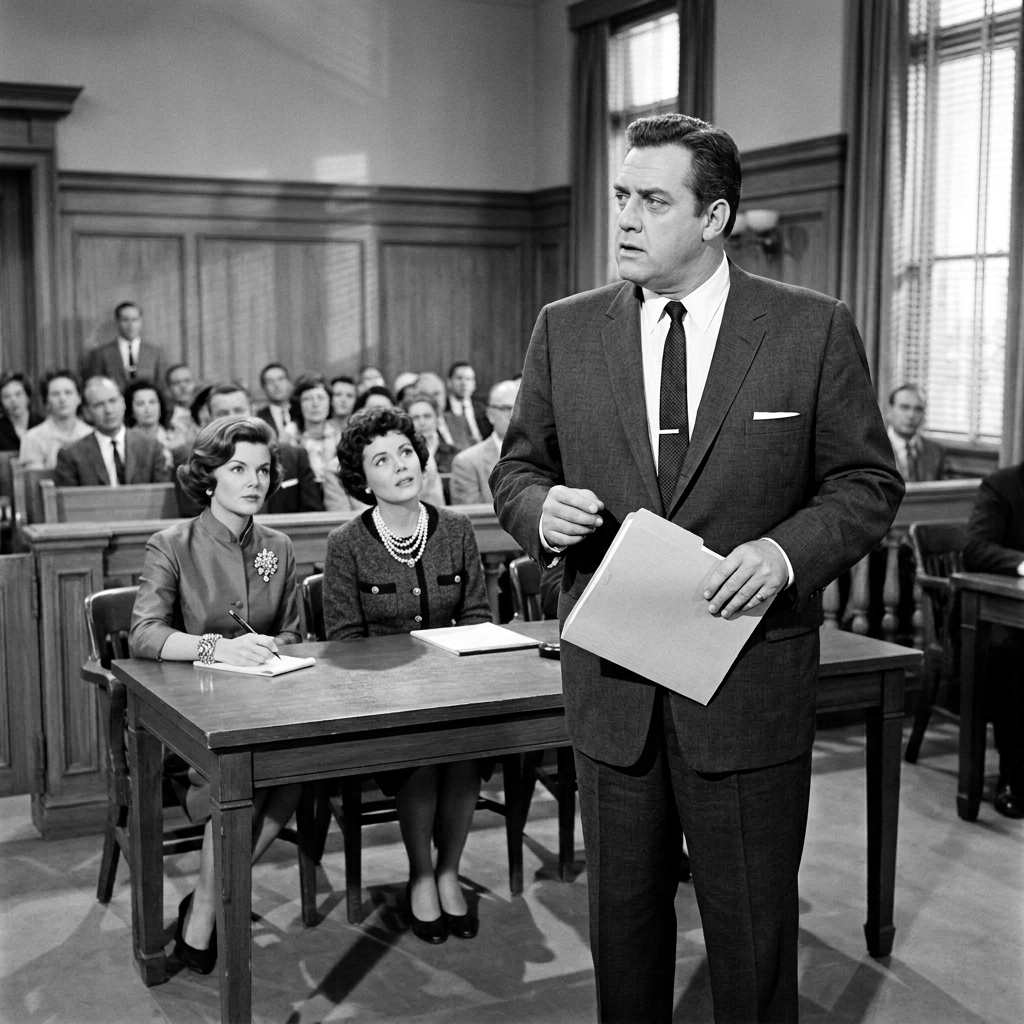
Back when I went to movie theatres (and new releases were actually worth watching), I’d always wait for the inevitable trailer with when some very serious guy in a deep baritone would say, “In a world…” Then he’d follow by describing whatever the heck world that particular picture was selling for the next couple of minutes. You would pretty quickly decide if it was a world worth visiting.
I think of that “in a world” intro when I do my more than occasional bingeing of the most influential television courtroom drama ever, the acclaimed original series version of “Perry Mason”, which ran from 1957 to 1966, and gave us a glimpse of the kind of legal system we could all get behind.
When it comes to Perry Mason, accept no substitutes—while the great Raymond Burr’s return as the intrepid defense lawyer in 1985 for a series of Mason made for TV movies was a nice reprise, and Matthew Rhys’ later HBO streamer did an interesting post-modernist spin on the venerable character, I urge you to go back to the black and white, noirish legal procedural that made Burr a household name and created a blueprint for all legal dramas that came after it.
But back to that to that “In a World” intro:
In a world where only the guilty are punished and the innocent go free;
Where a defense attorney will only take on a client he knows is innocent;
Where a district attorney is only concerned with justice, and will even throw a case or- perish the thought- cooperate with the defense to ensure justice is served;
Where an aging police lieutenant can blow case after case and still keep his job;
Where good always triumphs over evil;
It is here—and only here—in the 271 episodes of Raymond Burr’s “Perry Mason”.
There’s a reason that I convalesced after two major surgeries by watching episode after episode of the original “Perry Mason”. I knew at the beginning of an episode, if the world is off kilter, it will be set on its rightful course by the time Perry and his friends, usually the stalwart Della Street (an elegant Barbara Hale) and his intrepid private eye Paul Drake (the suave yet self-deprecating William Hopper) are doing their amiable post-mortem about yet another winning case.
Some might sniff that the Mason series was formulaic and boringly predictable after the first ten minutes (around when the redoubtable Burr makes his first appearance). But that was part of its charm, and why the show is so eminently watchable sixty years on.
By minute fifteen, the murder has been committed, the alleged murderer has done something to bring suspicion on them, the smugly self-satisfied Lt. Tragg (the Mercury Theatre’s stalwart character actor Ray Collins) is boasting that he’s got his man (or woman) and—most important—our hero Perry has agreed to take on the case, either for a lot of money or no money at all (the latter if the accused is a damsel in distress. In fact, one imperiled defendant retains him for 38 cents, the only money she can fish out of her purse).
Then there are the classic “tells” at the beginning of the episode that signal who is going to be killed and who will be blamed for the killing. If someone is mean and nasty, or engaging in blackmail, or threatening to cut a blameless heir out of their will, or just generally driving everyone in their presence crazy from their overall orneriness, they’re usually dead in short order. And they’re usually so insufferable that you’re happy to see them go.
If prior to his or her demise that person sets up a meeting late at night at their home with Perry, it’s even money that Perry will find them sprawled on the floor, dead as a doorknob. Then the question is: was he (and it’s usually a “he”) killed by a fireplace poker, table lamp, gun or any other appliance or utensil that happened to be handy? But was he really killed by the poker? How about the doorknob itself? Did the blow on the head by the accused cause a momentary concussion, while the real murderer came in later to finish him off? Or, how about the half dozen or so episodes when the accused person actually is hit over the head and knocked unconscious, only to awake to find he’s sharing the room with a dead body? Maybe it isn’t a blow on a head or a gunshot that does the nasty antagonist off—perhaps it’s poison. These are the kinds of questions that take up a good part of Act 2 of just about any Mason episode.
The hapless Tragg, who you think might learn some humility, at least by about the fiftieth episode, given that he arrests the wrong person every week, generally has good reason to put the accused into those uniformly dingy (but always for some reason perfectly fitting) outfits they wear when Perry makes his inevitable visit to the county jail to confer with his client. My favorite is when a character says to the soon-to-be victim, usually in front of a roomful of witnesses, “if you do that, so help me, I will kill you”—an easy tip off that they’re going to spend some time in the hoosegow. I’ve lost count of how many Perry Mason defendants threaten another character with murder or say they’re going to commit murder, when in fact they end up not being the murderer.
Another main criticism of the series is that just about every episode features someone either from the witness stand or the gallery admitting they’re the killer, usually like clockwork with about four minutes left in the episode. That just seems so, shall we say, unrealistic. But put yourself in the killer’s place. He or she has to sit there virtually immobile, while the huge, implacable Raymond Burr as Mason prowls like a restless lion around the witness box, stalking his prey, his voice rising and falling, leaning into their personal space, his glowering dark eyes boring a hole through the witness’ brain pan. You might finally give it up just to seek protection from the guy.
Raymond Burr was a hyper-mature forty years old by the time he took on the role of Mason, and while always struggling with his weight, was a darkly handsome man who used his physical presence as an arrow in his formidable acting quiver. Burr had carved a niche for himself as the “heavy” in a spate of classic film noir movies for the previous decade, although he was possibly best known to movie goers as the murderous Lars Thorvald who captures the attention of James Stewart’s wheelchair-bound hero in Alfred Hitchcock’s classic “Rear Window” (1954).
Burr beat out fifty other actors for the role of “Mason”, losing sixty pounds at Executive Producer Gail Patrick Jackson’s request before doing his screen test. When he saw Burr as Mason on screen, Mason creator, mystery writer Erle Stanley Gardner, reportedly leapt up and said, “that’s him! That’s Perry!”
Truer words were never said. There have been only a handful of dramatic roles in television history where it is impossible to even conceive of another actor in the part. Several come to mind– David Janssen’s tortured, brooding Dr. Richard Kimble in the 1960s original television version of “The Fugitive”; Telly Savalas’ lollypop sucking Lt. Theo Kojak, who made bald sexy and “who loves ya, baby?” a popular tagline; James Garner’s amiable Jim Rockford in “The Rockford Files”, a show that was built around Garner’s easy to like persona; and, of course, Peter Falk’s completely original portrayal of the slyly intrepid LAPD Lt. Columbo, who almost single-handedly kept Peugeots on the road and rumpled trench coats in style in the seventies.
But Raymond Burr created the template for these succeeding characters. Rarely has anyone ever dominated the small screen to the extent that he did. To say he physically takes up most of your television set is not hyperbole. And what was most remarkable is that he accomplished this dominance with such dramatic economy. No one has ever squeezed more meaning out of a stony look, a raised eyebrow or tug of the ear than Burr. He could shift gears from studious to supportive to angry while opening his briefcase.
My favorite Burr moment inevitably comes when Paul Drake dramatically enters the courtroom when all seems about lost and hands Mason a small scrap of paper, which after reading it Mason wryly smiles. He then looks out at the gallery to find the person the note implicates, at which point that person either starts trembling uncontrollably or heading for the exits. Or, if it’s the witness on the stand that the note implicates, he quickly pivots to them and, within about thirty seconds, the witness is a blubbering mess, ready to call it a day.
Burr was more than a dominant small screen presence as Mason for almost a decade. He was an unfailingly kind colleague and fierce supporter of his co-stars. Perhaps the most famous example of this was his support of the ailing and mentally failing Collins, who was up to only sporadic appearances from season four through seven, with his last appearance in January 1964, a year before emphysema took his life. Burr insisted that the producers maintain Collins’ co-star billing until his death, so that Collins would be able to maintain his health insurance benefits through the Actor’s Guild. Burr was also instrumental in reinstating the scandal-plagued William Talman as district attorney Hamilton Burger in 1960. When Talman, dying of lung cancer in 1968, was featured in an anti-smoking public service announcement, prominently placed next to him was a framed photo of Raymond Burr.
For her part, Barbara Hale was lifelong friends with Burr going back to the 1940s when they were both contract players at RKO Studios. When the producers of the Mason movie series asked her to reprise her role as Street after Burr’s death in 1993, she declined, saying that she couldn’t imagine ever playing the part of Della Street opposite anyone other than Burr. While having a chaste relationship throughout the series run, the chemistry between the two was palpable and the true affection they had for each other readily apparent. In fact, the Mason set appears to be an unusually happy one, with Burr largely responsible.
While Burr’s existence as a gay man was a closely guarded secret throughout this career (with Hale being only one of a handful of friends who knew about it) it had no bearing on his not having a heterosexual love interest in “Perry Mason”. Fans rooted for Perry and Della to become romantically involved, but the fact was that Erle Stanley Gardner made a strict prohibition on romance a prerequisite for selling the rights to the character to television. Gardner insisted that the focus of each “Perry Mason” episode be solely on the plot, the mystery behind the plot and the legal maneuvering around the case.
Perry Mason is still my go-to when times are tough and I need a pick me up, or a break from the reality I find myself in. It is chicken soup for the soul and a balm for my sometimes-flagging spirit. I don’t know what I would do without Perry. And I have no doubt that Perry himself would be at a loss without the irreplaceable Raymond Burr.


Leave a Reply