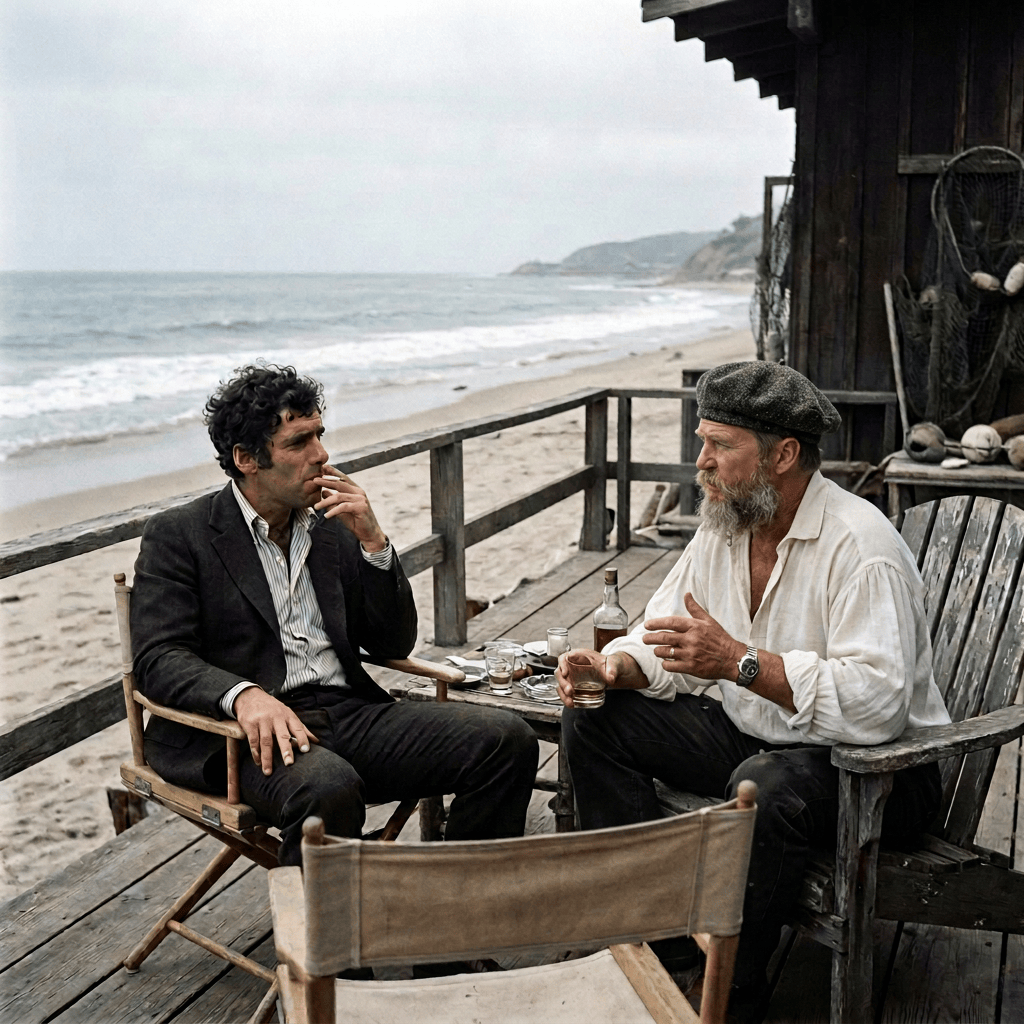
If you only know octogenarian character actor Elliott Gould from his roles as surrogate father figure to fixer Ray Donovan, in the series of the same name, and more recently as “Legal” Siegel, the avuncular advisor without portfolio for the complicated, perpetually endangered defense attorney Mickey Haller in the Netflix streamer “The Lincoln Lawyer”, you would never know that he once upon a time defined the decade of the Seventies.
To put things into perspective, Gould guest hosted six “Saturday Night Live” episodes between 1976 and 1980, at the time a leading indicator of the host’s personal coolness. He hasn’t guest hosted since. Gould hosted SNL when it—and he—was at the apex of their coolness.
Time waits for no man, and while it’s a tribute to Gould that he has worked steadily first as a leading man and then as a sought-after character guy for sixty years, you really need to set your wayback machine to the mid-seventies to appreciate just how profoundly Gould reflected the hyper-cynical, hipster, insouciant vibe that defined much of America as we struggled with the huge hangover from the tumultuous sixties.
In the 1980 Louis Malle film “Atlantic City”, a venerable Burt Lancaster as the aging hood Lou gives in to his nostalgia for old times as he and his lady friend (Kate Reid) stroll down the Boardwalk. As they walk arm and arm, Lou looks out at the water. He says to her, “the Atlantic Ocean was something then. Yes, you should have seen the Atlantic Ocean in those days.” I would say the same thing about Gould– you should have seen him back in those days, years before he became best known to moviegoers as the impotent, intimidated boyfriend of the mother of the violent, racist Edward Norton in “American History X” (1998) and to nineties TV sitcom watchers as Ross’ and Monika’s dad in “Friends”.
After making his mark in Paul Mazursky’s controversial, critically successful “Bob & Carol& Ted & Alice”, Gould made a number of forgettable films in the early to mid-1970s (ever heard of “The Touch”? “Quick, Let’s Get Married”? “I Love…My Wife?” “Move?”. Me, neither.) He also had near career ending meltdown making a movie that ultimately morphed into a vehicle for his more famous ex-wife, Barbra Streisand, Peter Bogdanovich’s classic screwball comedy, “What’s Up, Doc”.
It is likely that Gould could have been consigned to the dustbin of movie history were it not for a series of collaborations with quintessential 70s director Robert Altman from 1971 to 1975. Altman’s movies became the perfect medium for the Gould persona—someone who acts like he couldn’t care less about anything going on around him, believing that the world was basically a movie and he was playing a part—and not especially doing that well with it, but hey, it was ok with him.
There’s his Trapper John, all wisecracks and Hawaiian shirts, kibbitzing his way through the Korean War in the 1971 black comedy “MASH”. In 1974 Gould played Charlie Waters, his harassed, financially destitute gambler character in Altman’s “California Split”, displaying the same disaffection with society and himself, replacing Korea with a poker table and leading cohort George Segal into a variety of hijinks that skirted the borderline of legality. In both characterizations, Gould doesn’t really seem to be acting; there’s an improvisational aspect that makes you really believe Gould is playing himself—and more importantly, that his disaffection for and distrust of everything around him is not a pose.
Gould has a walk-on role playing (who else?) himself in Altman’s magnum opus, “Nashville” (1975), showing up at famed bantam rooster country singer Haven Hamilton’s (Altman stalwart Henry Gibson) mega-party. We’re happy to see him in an entirely different milieu, but not as happy as groupie-cum-journalist Geraldine Chaplin’s character, who ditches Haven’s son Buddy in mid-song to cozy up to a real- life Hollywood star. What’s impressive in this scene is that while Gould shambles his way as usual through it, looking bemused and a bit surprised at all the fuss over these country and western stars he knows nothing about, he never appears condescending or belittling. It’s as if he’s demonstrating that he understands the disposability and ephemerality of fame. When Ned Beatty as the front man for a populist candidate running for president doesn’t recognize Gould and is embarrassed about it, the actor sloughs it off as no big deal, that there’s really no reason for him to expect that Beatty would have any idea who he was.
Sandwiched between these films is the heart of Gould’s brief but profound multi-year collaboration with Altman, which cements the actor’s place in the pantheon of ‘70s anti-heroes and creates a blueprint for the sensibility of the seventies in mid-decade. I refer to a commercial and critical failure now considered a classic of the neo-noir genre, Altman’s reimagining of the classic noir era called “The Long Goodbye” (1973), with the director bringing novelist Raymond Chandler’s most notable creation, cynical detective Phillip Marlowe, into the seventies, but preserving the knight-errant quality of his iconic private eye. There are have been many great neo-noirs made in the past fifty years, and some great actors who have played Marlowe (Humphrey Bogart at the top of a distinguished list), but no one that comes close in style, tone or attitude to Gould’s entirely original interpretation of this character.
Interestingly, Michael Connolly, the Lincoln Lawyer’s creator (and by extension responsible for Gould’s latest regular paying gig), took as his inspiration Gould’s performance as Marlowe when he chose as a career writing detective novels.
Altman’s brilliant conceit was, first, to pick Gould over producer Elliott Kastner’s more traditional choice for the part, Robert Mitchum (who later starred as Marlowe two years later in an excellent albeit much more traditional adaptation of a Chandler novel, Dick Richards’ finely crafted, wistful “Farewell, My Lovely”). And then to have Gould as Marlowe essentially wake up from the forties to find himself in the seventies, the only person in the movie wearing a black suit, black tie and eighty-pound wing tips while everyone else is living very much in the present. Altman called his character “Rip Van Marlowe”, to underscore the contrast between Marlowe’s sense of post-war morality and the chaos that swirls around him in contemporary Los Angeles. At this point, who better to channel the forties through the strainer of the seventies than Elliott Gould?
What do you do when you wake up from a thirty-year slumber? The first thing you do is feed your cat, which Gould turns into a drawn-out comedy routine, with the cat showing off his own detective skills by figuring out that his owner is trying to con him into eating an off-brand cat food. It is a lesson in futility that will play out continually through the rest of the film.
It is entirely appropriate that the catch phrase most associated with not only “The Long Goodbye” but possibly the entire decade was improvised by the quick-witted Gould, “it’s ok with me”. Altman liked the line so much that he made it a recurring phrase throughout the picture, reflecting Marlowe’s acceptance of things that he cannot relate to or understand. There is a throughline from that phrase to Altman’s use of Keith Carradine’s “It Don’t Worry Me” as the de facto theme in “Nashville”. (Interestingly, it’s a different Carradine song from the movie, “I’m Easy”, that won the Academy Award that year).
Much has been written in retrospect about this remarkable neo-noir, which is entirely a product of the seventies but at the same time honors the classic film noir genre in profound but subtle ways. There’s the casting of legendary noir leading man Sterling Hayden as Roger Wade, the larger than life, alcoholic, writer’s block-stricken author, around whom much of the plot revolves. And, there’s Mark Rydell, himself a noted director, as mobster Mickey Augustine, channeling Lee Marvin’s depraved villain in the Fritz Lang classic “The Big Heat”, reenacting that 1953 movie’s stunning moment of unthinkable cruelty. Added to the mix to bring us back to the current time is the inspired casting of Nina Van Pallandt, girlfriend of infamous fraudster Clifford Irving, as the femme fatale and Hayden’s scheming wife, and the semi-stunt casting of former Yankee turned author Jim Bouton as Marlowe’s friend Terry Lennox.
If there is a through line to these great Gould performances, it is his sense of loyalty to his friends, as it is the one thing that tethers these characters to a sense of purpose and dignity in a world that seems completely random. Which is why the climax of “The Long Goodbye”, which has (spoiler alert!) Marlowe execute in cold blood his longtime friend, seems at the same time completely out of left field yet entirely appropriate. And it is a complete departure from Chandler’s novel, where the movie fulfills its neo-noir destiny.
The final shot of the other great contemporary detective neo-noir of the mid-seventies, Arthur Penn’s “Night Moves”, shows us Gene Hackman’s tortured detective Harry Moseby alone, wounded and possibly dying, wandering in circles in a damaged boat in the middle of the Atlantic Ocean, lashing out in an impotent rage, having figured out nothing about himself or the mystery he was trying to solve. In contrast, at the end of “The Long Goodbye”, Elliott Gould as Phillip Marlowe gets his man, the friend who betrayed and made a fool out of him, and for whom he risked jail and possibly his life. Obviously, not everything is ok with Gould or Marlowe, after all. When Lennox essentially tells Marlowe to chill, and that “nobody cares” about what happened to his wife, Marlowe responds, “yeah, nobody cares but me.”
The final shot of Gould dancing his way down a dirt road in Mexico with the tune of “Hooray for Hollywood” playing on the soundtrack, we’re back to the actor’s more familiar ironic pose, as everything again is ok with him. It is one of the great final scenes of the seventies, and represents yet another Altman homage to classic noir, this one a callback to the famous final scene in Carol Reed’s peerless “The Third Man” (1949). We soon said goodbye to the Altman conception of Elliott Gould, but only after a last hurrah in 1978, in an adroit Canadian-produced thriller called “The Silent Partner”, with Gould matching wits with a truly terrifying Christopher Plummer. Gould starts the movie as a nerdy, nearly invisible bank teller but by the second act has emerged as the clever, improvisational cool cat that we had come to expect, or at least hope for, even at that late date. By the eighties he was doing supporting roles and made for TV movies, with “Friends” in his future. It turned out that Gould was an anti-hero that only the seventies could love.


Leave a comment