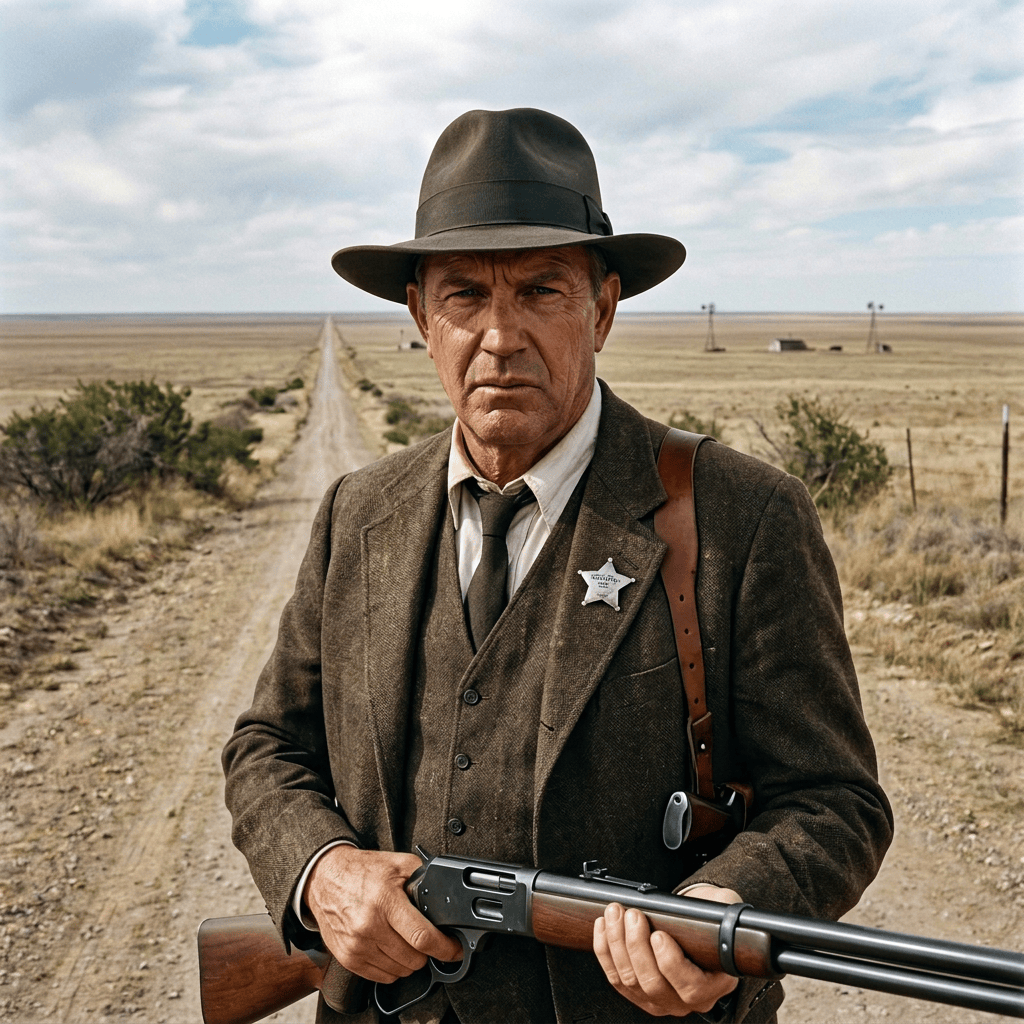
It’s a pivotal scene in a pivotal movie in motion picture history.
Toward the end of Arthur Penn’s “Bonnie and Clyde” (1967), a Texas lawman creeps up on the Parker-Barrow Gang, but before he can lower the boom, the gang gets the jump on him and ties him up. What happens next is the ultimate game of “poking the bear”. They clown around with him, make him pose for pictures, and have a great time humiliating the guy.
At one point, Bonnie (a luminous, 26-year-old Faye Dunaway, turning in a performance for the ages in only her third film) kisses him as a gag, and in return the humiliated lawman spits at her. At which point the fun is over, and Clyde Barrow (Warren Beatty, both producer and star of the movie that elevated him from notorious playboy to serious filmmaker), literally sends the outraged officer down the river.
In real life, no encounter with this particular lawman would ever end that way. Because that Texas lawman isn’t just any guy in a ten-gallon hat wearing a badge. He is the legendary Frank Hamer, the pride of the Texas Rangers, and reputed to be the meanest, most relentless law enforcement officer in the history of the planet. In “John Wick”, Viggo the mob boss famously tells his reprobate son that “John wasn’t exactly the boogeyman. He was the one you sent to kill the f—–ng boogeyman.” He neglected to add that you would only send for Wick if Frank Hamer was on vacation.
You wouldn’t know that by watching “Bonnie and Clyde”. For director Arthur Penn, the Hamer character was a foil to his glamorous, impossibly beautiful young couple in their homicidal dash across the depression-era Southwest. To play Hamer, Penn tapped 47-year-old Denver Pyle, a classic “that guy” and future oil man perhaps best known for his recurring role on “The Andy Griffith Show” and as Doris Day’s father on “The Doris Day Show”. Pyle as Hamer ultimately manipulates Buck Barrow’s recently widowed wife (Estelle Parsons, in a well-deserved Oscar-winning supporting performance) into giving up the name of the gang’s getaway driver, coming off as a heartless bully preying on the fragility of a frightened, grief-stricken blind woman. Not exactly heroic stuff. And that’s entirely by design.
“Bonnie and Clyde” was celebrated as a visionary cinematic tour de force that ushered in a new era of American filmmaking, marked by the auteur-driven, highly personalized fare that dominated Hollywood through the mid-seventies, generally summed up in the phrase, “the New Hollywood”. Some would say that it also introduced the concept of the anti-hero to American filmgoers, already a staple of the much ballyhooed “French New Wave”, featuring directors that Penn and others revered, like Jean Luc Godard and Francois Truffaut, who blurred the lines between good and evil and made moral relativism cool.
Not everyone was enthralled by the film. Bosley Crowther, for three decades the principal movie critic of the New York Times, became a casualty of “Bonnie and Clyde”, penning several scalding columns bemoaning the amorality of the film that cemented his reputation among the younger critics as a hopeless dinosaur and led the Times to put him out to pasture.
The Hamer family was less than enthralled by the film, too. They considered Penn’s portrayal of the dead Texas Ranger (Frank Hamer passed away in 1955) a willfully malicious and scurrilous lie. The family sued Warner Bros/Seven Arts for defamation of character, and they received an undisclosed out of court settlement in 1971. But that did nothing to publicly rehabilitate Hamer, who had famously avoided the media during his life and did nothing to undo the damage done to his memory by Pyle’s characterization of Hamer by the time of his death. For that, it took five decades and three men– Hollywood icon Kevin Costner, respected veteran director and Texas native John Lee Hancock and screenwriter John Fusco– to set the record straight.
Fusco’s script for the Netflix 2019 release “The Highwaymen” depicts the Bonnie and Clyde manhunt from the perspective of the lawmen who brought them to justice, the aforementioned Hamer (played with gravitas and a boiling under the surface intensity by a career resurgent Costner, one year into his late-career defining role as the patriarch of the Dutton family in the spectacularly successful Paramount streamer “Yellowstone”) and his avuncular, wisecracking sidekick Maney Gault (Woody Harrelson, who matches Costner scene for scene.) In fact, Hancock and Fusco purposely hide the malefactors from sight, ensuring that the audience remains detached from them as people and focused on their heinous deeds.
It’s good to have a legend available to play another legend, and it was director Hancock’s great fortune to have one in Kevin Costner. The director’s handling of Costner’s performance evokes echoes of the star’s 40-year filmography, and it gives his interpretation of Frank Hamer added resonance and weight. Hancock’s first shot of Costner as Hamer is from behind the actor, as he looks out at the horizon, absorbed in contemplating his life and what might be in store for him. Hancock immediately establishes the tone and takes full advantage of Costner’s star quality, making it clear that this is going to be Frank Hamer’s movie.
Costner’s riveting star turn comes almost thirty years after his first run through the Texas panhandle as Butch Haynes, a sociopathic killer with a soft spot for his young abductee in Clint Eastwood’s overlooked, underappreciated gem, “A Perfect World”. In a role reversal that was doubtless not lost on either Hancock or his star, Eastwood played another former Texas Ranger, Red Garnett, in the 1993 film.
Costner, 63-years old at time of filming (Hamer was 50 years old when he hunted down and killed Bonnie and Clyde), brings an exasperated, world-weary sensibility to the role of Hamer, depicting a man conflicted about taking on the chase, but determined to see a difficult job through.
From the jump, we know that this is not your father’s (or grandfather’s) “Bonnie and Clyde”. The 1967 film begins with a tight close up of Bonnie (Dunaway), applying lipstick, and looking approvingly at her own profile before sensuously parading around her bedroom like a caged animal while the camera tightly and lovingly follows her every move. This opening scene is like none other before it in American film history. Without any exposition, the three minutes we spend with Bonnie defines her character, sets the course for the film, and ultimately shakes up an entire industry, dismantling whatever was left of the crumbling Hays Production Code, which had been governing American movies for more than thirty years.
There are no such close ups of the murderous Bonnie in “The Highwaymen”. The movie begins with a gauzy shot of a late-model car coming up a heat-drenched road. A well-dressed woman only seen from the waist down limps out of the car toting a submachine gun that’s almost larger than her. A chain gang breakout is about to take place, and the woman erupts with machine gun fire (which we see from a long distance) to cover the escapees’ flight to freedom. One guard is left dead and another seriously wounded. This is our bloody introduction to the “The Highwaymen’s” version of Bonnie Parker and Clyde Barrow.
The prison break is the last straw for the frustrated Texas Governor Miriam A. “Ma” Ferguson (a scene-stealing performance by Academy Award-winner Kathy Bates) leading her against her own better judgment to agree to pay Hamer, of late unemployed as a result of the governor’s disbanding his famed Texas Rangers, to pursue the rampaging, lethal gang. At first when the suggestion of hiring Hamer is raised, Ma scoffs, saying “well, sure, why don’t we just dig up Wyatt Earp?” (a callback to Costner’s performance as Earp in his version of the legendary gunfighter’s life in 1994).
There’s an early scene that establishes how large Hamer loomed in the American imagination- and how far he had fallen during his forced retirement. Hamer, clearly rusty from disuse and playing house husband to his beloved Gladys (an understated, effective Kim Dickens), enlists some local boys to throw bottles in the air as target practice. Hamer, embarrassed by his ineptitude, pays the boys to keep quiet about it. As he walks toward his car, the savviest of the three urchins says, “was you really Frank Hamer?” The lawman just turns and walks away, speaking volumes without saying a word.
If there a conscience to the movie, it’s Harrelson’s Gault, totally loyal to his buddy “Pancho” but guilt ridden about the things the two have done to keep the peace, most notably a Hamer-led massacre of a Mexican band of criminals that left a 13-year-old boy dead at Gault’s hands. Gault has never gotten over the boy’s killing, but realizes his partner and best friend has no regrets, or at least will not allow himself to have them.
Where the two films align is in their troubling consideration of the nature of celebrity in America. We were starved for heroes during the Great Depression, and for many, Bonnie and Clyde filled that void. Both films depict the crushing poverty and desolation of the Depression-era south, the bitter resentment of the bankers that people blamed for the crash and how the thirst for celebrity can warp and corrupt people desperate for something to cling to in their lives. “Bonnie and Clyde” considers this phenomenon with a sense of wonderment and bemusement. “The Highwaymen” is horrified by it.
The contrast between the two movies is reflected in the scene in which Maney is reading the publication of Bonnie Parker’s doggerel poem about the gang. He says, “used to be you had to have talent to be published. Now you just have to shoot people.” The line foreshadows the fanboy and fangirl following of Luigi Mangione, cold-blooded killer of United Healthcare CEO Brian Thompson, and echoes the warped, enthusiastic cultish following surrounding the Boston Marathon bombers.
Later, the lawmen are closing in on the couple in a bustling small town, but they’re confused when every woman they see walking past them is dressed like Bonnie, wearing berets and close fitting knit dresses, in homage to their heroine. And, there’s the shocking final scene, where the town folks, driven to the brink of hive-mind hysteria, desperately tear at the corpses of the doomed couple as their death car rolls down Main St, grabbing at any item of clothing or jewelry they can take away as a remembrance of their heroes.
Meanwhile, Hamer and Gault part the scene in disgust after Hamer turns down a paid offer to do an interview with the Associated Press, driving out of town and hopefully back into the anonymity they crave. Hancock and Fusco are saying what we really should be fearful of is not the criminals in our midst, but of ourselves.
The climactic shoot out in “The Highwaymen”, shot at the exact location in Bienville Parish, Louisiana where the two murderers were ambushed by law enforcement in 1934, puts the punctuation point on these two radically different films. “Bonnie and Clyde’s” famous twenty-five second, slow motion ballet of death focuses on the lovers’ bullet wracked bodies and the horror of the violence wrought by law enforcement. “The Highwaymen” shoots essentially the same scene from the lawmen’s perspective as they unload a fusillade at the fugitive couple. “Bonnie and Clyde” is ambiguous about whether the couple is given a chance to give themselves up. In “The Highwaymen”, the pair clearly are reaching for their guns when Costner and company lower the boom. The scene in both movies could be described the same way, but the point of view of the two films is entirely different.
But the biggest injustice of all may be the critical and popular reception for “The Highwaymen”, which was lukewarm at best. There are two possible explanations. One is boomer nostalgia for the 1967 movie, as the same sixties college students so enthralled by the original work may have considered the Hancock/Costner movie a sacrilege fifty years later. Or it’s politics, as there are those who are offended by seeing police depicted as complex, sympathetic individuals doing a tough job as opposed to being the bad guys caricatured by the “defund the police” crowd.
For me, the movie is a reminder that in the immediate pre-COVID era, Hollywood was still capable of producing complex, adult fare. And, better still, it had the audacity to reimagine one of the most important movies of all time, finding justice for a fabled American in the process.
By Harlan Teller for “On Second Thought”
 On Second Thought
Leave a comment