For many of us in the great COVID era, “Top Gun: Maverick” was the movie that brought us back to the movie theater. It was thrilling in an old school Hollywood way, and, as with most Tom Cruise movies, the mega-star left it all up there on the screen. Like him or hate him, you can never say that Tom Cruise doesn’t give you your money’s worth. The consummate movie showman and a true believer in the power of motion pictures, Cruise even filmed an introduction to the “Top Gun” sequel, thanking his audience for coming back to the movies, which for many meant coming back to Tom Cruise.
But for all the pyrotechnics of the movie–and for being thankful that the stunning, ageless Jennifer Connelly still looked, well, stunning and ageless—the movie for me came down to a three-minute scene between Cruise as Maverick, and Val Kilmer as Iceman, his lifelong friend and rival, his movie character as well as Kilmer himself about to pass on to the next life. It was one of those rare times when what’s on the screen becomes achingly real. The two actors both knew that this would be the final scene that Kilmer would ever appear in. Kilmer, dying at the time from throat cancer and having lobbied to reprise his “Top Gun” role, tells Cruise via computer “it’s time to let go”.
The power of the scene comes with the realization that these two guys weren’t acting. They were saying goodbye to each other after a 40-year friendship, using celluloid as their medium. On screen, Kilmer as Iceman pleads with Maverick to let go and move on to the next phase of his life. But in reality, it was Kilmer saying a final goodbye to his friend, telling him that it was okay to let him go. Both actors had tears in their eyes while shooting the scene, as I’m sure did many of the sixty-eight million Americans who saw the movie in theaters across the country. I certainly did.
The sad fact is, however, that we had let go of the brilliantly talented Kilmer long ago, when a combination of erratic. temperamental behavior on multiple films, just plain bad luck (like having to pass up a key role that would have reunited him with Cruise in Michael Mann’s neo-noir classic, “Collateral” because of a schedule conflict), a slew of forgettable direct-to-video films, and ultimately, adding insult to injury, a terminal disease that literally robbed him of his ability to speak, dimmed his celestially bestowed talents.
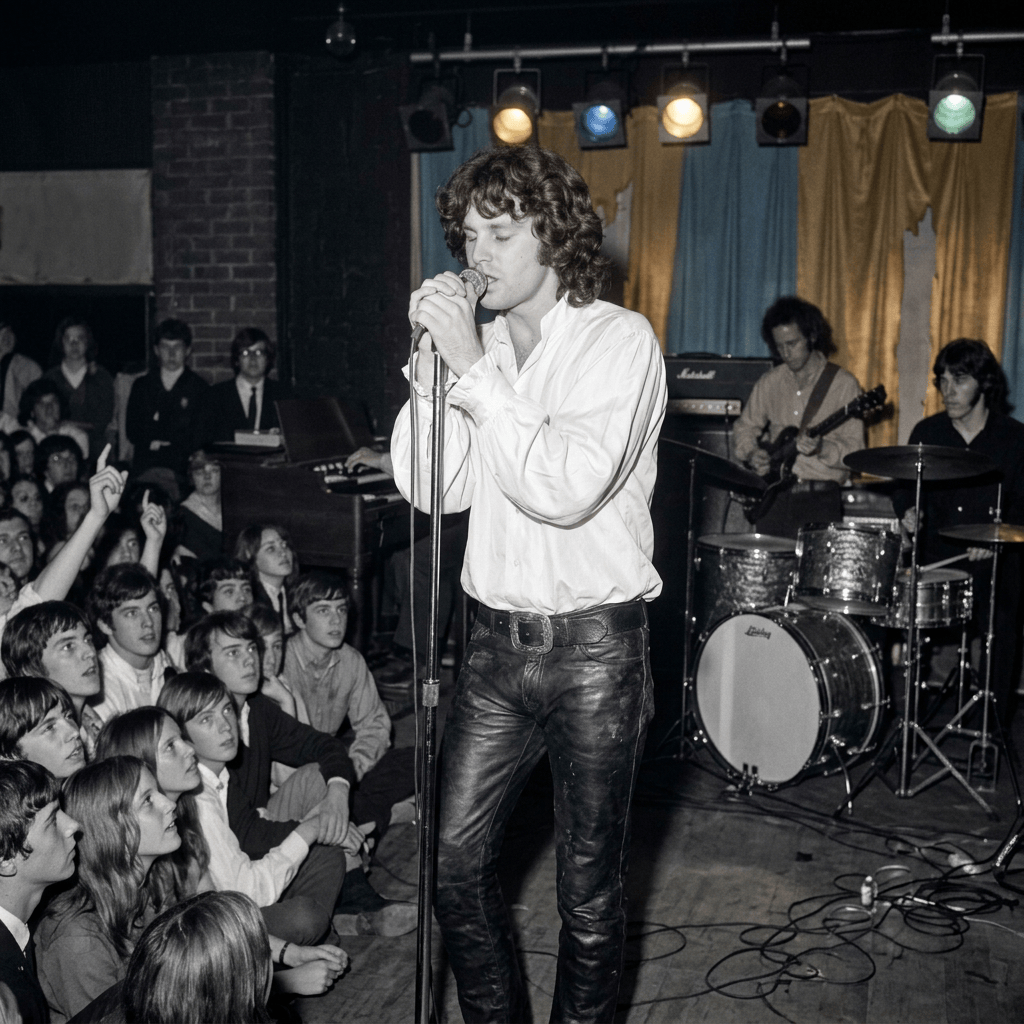
I remembered a time more than 25 years before when I saw another film in which Kilmer wasn’t so much acting as inhabiting the soul of someone long-dead but whose reputation still burned brightly. My friend Lester and I waited in a long line in a misty opening night in Skokie, Illinois at the Old Orchard Theater back in 1991 to see Oliver Stone’s completely bonkers tribute to the greatest rock and roll singer of all time, the Lizard King himself, James Douglas Morrison, and the remarkable group of musicians he chaotically led, a movie simply called “The Doors”.
Stone’s depiction of Jim Morrison wasn’t so much a characterization of the singer as it was an overlong, rambling, episodic, self-indulgent testament to the director’s favorite era, which, as for most of us boomers, was the sixties. “The Doors” is rife with memorable set pieces, including the glorious anarchy of the Venice Beach scene, a pagan, drug-induced blood ritual with a witchy woman (a compelling Kathleen Quinlan), young Jim seeing “Indians on dawn’s highway bleeding” (a classic Morrison line from the song “Peace Frog” and a recurring motif in the film) and even a glimpse of an almost weirder than real life Andy Warhol (a predictably creepy Crispin Glover). It was probably best consumed after a few bong hits, which regrettably were not available at the theater that night.
My love of The Doors and their mercurial, self-destructive front man began almost three decades before, at age 14, in the basement of my friend Steve’s house. After school, we’d repair to Steve’s and we’d hang out and listen to records, mainly 45’s when it was especially daring to listen to the B sides of hit records, which were often time wasters not intended for regular consumption.
One afternoon, after listening to “Light My Fire”, the song that made The Doors famous and at the time number three on the local WLS Radio’s “Silver Dollar Survey” (ultimately becoming elevator music a generation later), Steve flipped the disc over to put on the “B” side, a song called “The Crystal Ship”. Even in my raw early teens, I knew I was listening to something unlike anything ever recorded. It sounded like space aliens had come down to our planet to show we earthlings how music should really be made.
Sixty years on, the vise-like grip that “The Crystal Ship” exerted on my psyche still holds. The two and a half minute recording, moody and melodic, lyrical and metaphorical, anchored by a brief but gorgeous keyboard solo by the peerless Ray Manzarek (the backbone of the group and keeper of the Morrison/Doors flame) and Morrison’s spooky, elegiac vocal, is emblematic of the early Doors, whose first two albums, the eponymous “The Doors” and “Strange Days”, feature some of the most unique, evocative and, yes, otherworldly tunes ever committed to vinyl.
After that, things started to go off the rails for the Doors, with the sometimes brilliant but ultimately uneven “Waiting for the Sun” arriving as their third album. Then the train about jumped the track with the overproduced “The Soft Parade”, made infamous by the orchestrated pop strains of the Top 40 hit “Touch Me”, which featured a parodic Morrison singing the words “stronger than dirt”, the tagline from a famous Ajax cleanser commercial, at the end of the song. (We could forgive him the Kinks-adjacent “Hello, I Love You” from “Waiting for the Sun”, but “Touch Me” turned off all but the most rabid of Doors fans.)
Given the dissension in the band and Morrison’s by then legendary unreliability due to booze and drugs, not to mention a penchant for pulling stunts that put his life at risk, a Doors’ return to form was by no means assured. But return they did, and with a vengeance, getting back to their blues and rock roots with their fourth studio album, the rousing “Morrison Hotel”, anchored by the take no prisoners, full-bore, kick-ass rocker “Roadhouse Blues”. The cut features a growling, full-throated Morrison in vintage form fully engaged with his band, at one point urging virtuoso lead guitarist Robbie Krieger to “do it, Robbie, do it”, with the guitarist complying, unleashing a hyperventilating guitar solo that sounds as if the mild mannered Krieger was being chased across the recording studio by a demon.
The band followed that up with the equally strong “L.A. Woman”, a tribute to Morrison’s adoptive home that features his love letter to his city embedded in the title track. By then, Morrison was well on his way to drinking himself to death, and he finished the job in a bathtub in a Paris apartment on July 6, 1971. He was twenty-seven years old, although the autopsy showed that he had the body of a man of fifty.
Almost exactly twenty years later, Morrison was a rock legend in aspic and Kilmer, just thirty years old and two years away from taking on his most famous and universally acclaimed role, as the perpetually glistening, tubercular, quick-witted and self-deprecating Doc Holliday (everyone’s favorite Huckleberry) in George Cosmatos’ “Tombstone”, was reaching the peak of his formidable powers as an actor. For a brief time in that Skokie theater, Kilmer, through some kind of otherworldly alchemy, brought Jim Morrison back to life for me.
I don’t know if he was a man possessed by the dead singer’s spirit, or if Kilmer was just that damned good. Or, it could have been the months Kilmer spent studying the Doors’ catalog and learning most of their songs by heart, memorizing video footage of the singer so he could talk and move like he did, living near where Morrison had resided in Laurel Canyon and dressing like him, including wearing his trademark leather pants for days on end. It is said that playing Morrison got so far into Kilmer’s head that he needed therapy to detox after the movie wrapped.
Everything he did, from the timbre of his voice and the dreamy, abstracted way he related to his girlfriend (a weirded-out, strangely cast Meg Ryan as the ill-fated Pamela Morrison) and his bandmates, to his mad, manic, unhinged, near-spastic movements around the stage, to the physically embodying a young man prematurely going to seed in only his mid-twenties, worked. Most incredibly, Kilmer channeled Morrison’s honey-tinged tenor/baritone vocals. He sounded so much like Morrison that it was reported that even the surviving Doors band members were fooled. It was as if the two men—one alive, one long dead—had morphed into one being.
Ten years after Morrison’s death (and ten years before “The Doors”), on September 17, 1981, Rolling Stone ran a cover story about him, saying “He’s Hot, He’s Sexy and He’s Dead”, the premise being that while the rest of us were getting older, a teenage cult following had developed around the ill-fated, still very much dead singer. There will be no such cover story written about his portrayer in Stone’s bio-pic, Val Kilmer, who lived long after his youthful sell-by date and at age 65 was almost 40 years older than Morrison had been at the time of the latter’s death. At the end, the Iceman was resurrected out of obscurity by his old friend Cruise, who provided him with a three-minute coda to an uneven, perplexing career that never fulfilled its promise but provided scintillating, indelible moments of brilliance, with his mesmerizing performance as the Doors frontman having a prominent place on any Kilmer highlight reel.
We know how the script ended for Val Kilmer, as his life had a full albeit ultimately tragic arc. But what about Jim Morrison, who departed the earth almost as quickly as he arrived, like a once brightly burning, now depleted comet? We will never know what he might have accomplished with an extra forty years to burn. To quote Morrison’s self-fulfilling, prophetic lyrics of “Roadhouse Blues” that could serve as his epitaph: “the future’s uncertain but the end is always near.” Words that Morrison in his brief, tumultuous life unfortunately took too much to heart.
by Harlan Teller for “On Second Thought”


Leave a comment