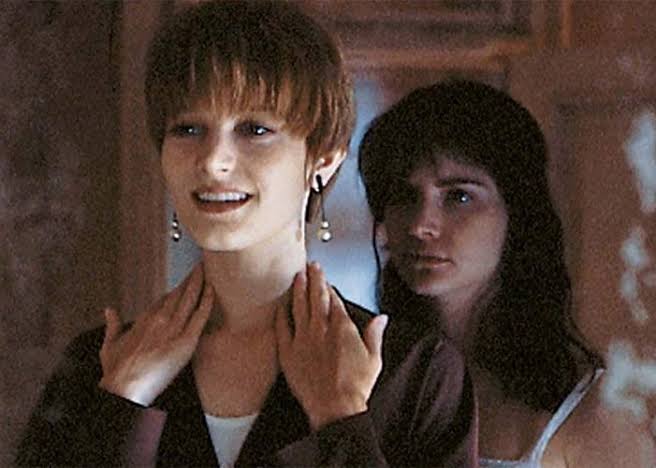
It’s a movie plot that represents a parable for our times, now that rent control is back in the news and, in homage to Will Ferrell’s character Jacobim Mogatu in “Zoolander”, is “so hot right now.”
A beautiful young woman named Allie (think a late twenty-something descendant of Hollywood aristocracy. Let’s say Bridget Fonda) lives in a rent-controlled apartment in Manhattan with a predictably bland upscale white guy (think Matthew Modine, although he evidently was tied up with another project at the time, so they dug through the “bland white guy” resume pile and came up with “Wings”‘ Steven Weber). Let’s say, just to spice things up, the rent-controlled apartment is in The Astonia, an iconic building on Manhattan’s Upper West Side, which is where the movie was actually shot.
Anyway…bland white guy gets caught cheating on his girlfriend (with his ex-wife, no less) and is thrown out of the rent-controlled love nest. Concerned about being able to make rent after being lowballed by her client for the sale of her proprietary software (the client being Stephen Tobolowsky, just before finding lasting fame as the doggedly persistent insurance man Ned Ryerson in “Groundhog Day”), she advertises for a new roommate. She is taken with an odd, sympathetic young woman named Hedy whose strangely endearing manner masks the fact that she is, well, strange, but not all that endearing (think a young Jennifer Jason Leigh, in a variation of the type of role she has made a meal out of ever since. In fact, it’s her.)
Allie accepts Hedy as her new roommate without checking references, credit history, pay stubs, all of the things that New York City is trying to do away with as I write.
Nothing to see here, right?
Well, no, unless you don’t count Hedy’s taking on Allie’s identity, holding her hostage, killing her boyfriend (only after seducing him in a scene I won’t describe since this is a family blog) and framing Allie for the murder, killing the Tobolowsky character execution-style, and even throwing in the murder of Allie’s beloved dog for good measure. (Doing in a couple of less than sympathetic men is one thing, but offing a cuddly dog? With the name “Buddy”? That’s beyond the pale).
Predictably, the tables are turned on Hedy, with Allie ultimately doing her in after an intense, prolonged climactic scene. Bland boyfriend, horn-dog client, adorable dog, and, most important, psychotic roommate– all dead by the end of the movie. What endures, like a cockroach surviving a nuclear bomb blast, is Allie’s rent-controlled apartment. And an expository, unnecessary voiceover from our heroine purporting to explain how Hedy’s guilt for her sister’s death drove her to homicide.
“Single White Female”, the name of the movie I just described, and its star, the gifted Bridget Fonda, are representative of an era in American (and movie) history, the anxiety-ridden early nineties, just before Fonda’s Generation Xers joined Fleetwood Mac in not stopping themselves from thinking about tomorrow, while getting busy constructing that Clintonian bridge to the 21st century.
The movie came out in 1992, the year that launched Bill Clinton to the presidency, and was bookended by the equally claustrophobic, foreboding “Pacific Heights” (1990), the John Schlesinger-helmed thriller that featured a creepy, manipulative renter (Michael Keaton, in his first role after being catapulted to superstardom playing Bruce Wayne and the title character in “Batman”) and the two unsuspecting, first-time landlords who rent an apartment to him (Melanie Griffith, hovering around her career peak, and the real-life Matthew Modine.)
Evidently the perils of property ownership and finding the appropriate roommate for your impossibly affordable rental were considered two sides of the same life-threatening coin to twenty-something Gen Xers before they found their footing and helped to propel the dot.com boom (and eventual crash) only a few short years later. Leave it to two non-American directors, Schlesinger (the British director of “Pacific Heights”) and “Single White Female’s” Barbet Schroeder (Iranian-born and a Swiss citizen) to tap into the most American of challenges, particularly in the recession-wracked early nineties- finding, financing and maintaining appropriately bourgeois housing stock. Schlesinger came out of the British New Wave, and looked at the American Dream with a clinician’s eye, beginning with the landmark “Midnight Cowboy” in 1968, still the only X-rated movie ever to win an Academy Award, an astonishing and groundbreaking choice by Academy voters that helped change the American cinema landscape.
Schoeder cut his teeth on French New Wave, demonstrating an interest in examining class structures, very much at the core of his previous American film, “Reversal of Fortune” (1990), featuring Jeremy Irons’ Academy Award-winning performance as the imperious, insufferable alleged wife murderer Claus Von Bulow.
In the early ’90s, it is not surprising that both directors would lock onto real estate challenges to explore life among the Gen Xers, as it was one of a number of issues weighing on their minds that made them anxious about the future and taking a curious interest in the Seattle rock scene.
By the mid-nineties, the Gen X slackers were becoming economically mobile, reflected in the spectacular rise in the US housing market. Seven million new homeowners were added to the market between 1994 and 2000, and overall, the national homeownership rate went from 63.9 percent in 1990 to 66.2 percent at the end of the decade. It is not clear whether homicidal tenants went up at the same rate in that period. Bottom line is that you could finally stop thinking about tomorrow because today there was a home mortgage loan application to sign.
At that point, Hollywood became less concerned with Gen Exers not finding their place in society and more with how their growing affluence would lead to a deadening of their senses and the loss of their souls. This is how you get a “Fight Club” at the decade’s end (1999).
By the time Fonda had taken on “Single White Female”, she was in the midst of a mind-blowing 32-movie run starting in 1987 and ending in 1999, a year after her indelible, unsettling performance as the Lady Macbethian wife prodding her everyman husband (Bill Paxton) into making a series of terrible decisions in Sam Raimi’s heartbreaking “A Simple Plan”. After traversing the that 21st century bridge, Fonda, safely delivered to the other side, retired from movies in 2002 to raise a family.
In the early to mid-nineties, though, only Winona Ryder would match and possibly exceed Bridget Fonda’s resonance as a Gen X actress icon. It is appropriate that Fonda and Ryder would headline the two movies that best exemplified Gen X hopes, dreams and mostly fears about the future, with Fonda headlining an ensemble cast as an aspiring architecture student stuck on grunge rocker Cliff (Matt Dillon in his early Gen X prime) in Cameron Crowe’s exploration of the Seattle scene in “Singles” (1992) and Ryder getting top billing as the aspiring film maker and free spirit Lelaina torn between bad boy Troy Dyer (Ethan Hawke, in his era-defining role as the ultimate slacker) and corporate type Michael Grates (Ben Stiller, adroitly directing himself in the straight man role) in “Reality Bites” (1994).
If Ryder was considered the alt-queen of Gen X angst, Fonda was the avatar for the upwardly mobile establishment wing of her generation, generally concerned with paying the rent, finding career fulfillment and the right guy (in “Singles”, she lowers her expectations to settling for a guy who will at least say “bless you” when she sneezes).
Fonda would throw herself into roles featuring smart, determined women coming to grips with difficult decisions in challenging environments that would have consequences for everyone around her. “Single White Female” might be the apotheosis for the Bridget Fonda 90’s persona. When she turns the ultimate rent control necessity, a screwdriver, into a lethal weapon, killing her tormentor after faking her own death, we totally believe that this smart albeit somewhat naïve young woman would be resourceful enough to get the better of her homicidal doppelganger.
Most bad ideas never die; they just live in suspended animation waiting to be awakened by a new generation that doesn’t know any better (or been threatened by a murderous roommate). Rent control may not generally result in the lethality at the heart of “Single White Female”. But according to famed economist, Thomas Sowell, what doesn’t kill you doesn’t necessarily make you stronger.
in his landmark book “Basic Economics”, Dr. Sowell contends that rent control is a net loser for all concerned. Rent control results in deteriorating housing stock as landlords have little incentive to invest in their property, and fewer choices for potential renters as investors who would otherwise put their money into multi-unit apartments find less risky, more lucrative places to invest. And, as an unintended consequence, you get less community cohesion, as society splinters into the haves (the upwardly mobile Allie’s of the world who hang on to their rent-controlled apartment for dear life) and have nots (anyone without a rent-controlled apartment, even if they have better judgment in their choice of roommates than Allie).
What may be most predictable about a rent-controlled apartment is that it takes some serious incentives to get a tenant to leave. Not even three murders, including the killing of her fiancé, convinces Allie to opt for a change in scenery. She figures it’s easier and less expensive to change her hair style than her living quarters. For her, life goes on and the rent stays the same.
by Harlan Teller for “On Second Thought”


Leave a Reply