For years my wife and I had two small dogs. Our Havanese, Coco, was a ball of love. She loved to be petted, played with and enjoyed being the center of attention. There wasn’t a mean bone in her doggie body, and Marsha and I loved her dearly.
Virtually everyone else in our family thought she was a huge pain in the ass.
Our other dog was a Pomeranian-Chihuahua mix named Rusty, who I would charitably call the “anti-Coco”. As long as you fed him once in a while, Rusty cared little about your existence. He walked around with an air of diffidence, and if you put him on your lap, he’d scamper off like he’d been scalded. Then there were the times that he was openly scornful of our authority, like the time I woke up in the middle of the night for a bathroom break to find Rusty on our second-floor landing, looking at me out of his disconcertingly bulging eyes with disdain. That look persisted as he picked his left leg up and proceeded to pee all over our carpeting, while staring a hole through me as if to say, “OK, big guy, what are you going to do about it? Just as I figured…nothing.”
Of course, all of our six kids in total loved him. They couldn’t get enough of the strange and seemingly anti-social mutt.
My line at Rusty’s passing was “never have so many loved so much and gotten so little in return.”
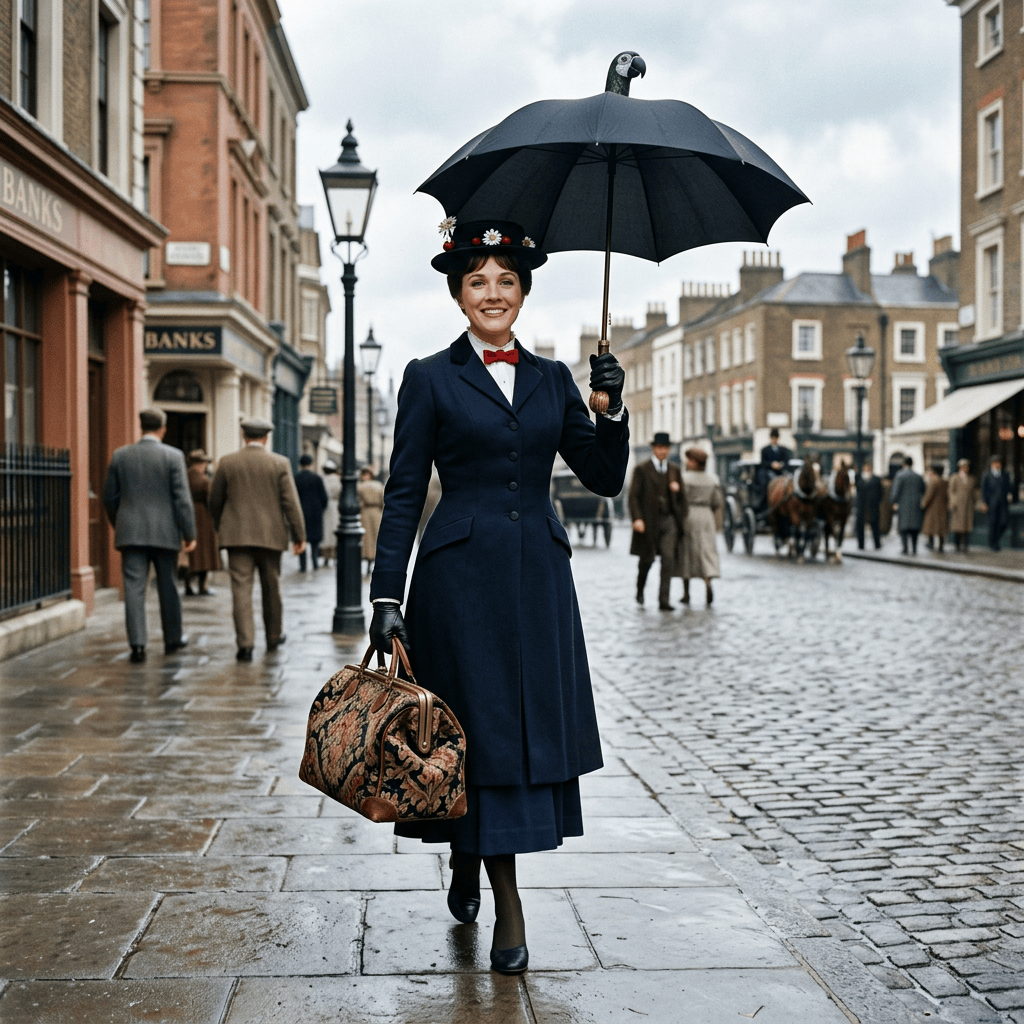
I thought of Rusty for the first time in a long while, when I rewatched Walt Disney’s iconic sixties fantasy, “Mary Poppins”, with my son Alex and granddaughter Loretta recently. At some point, it dawned on me that Rusty had a lot in common with the title character, the “practically perfect” Mary Poppins (at least in her own estimation). Like Rusty, just about everyone around Mary competed for her attention and approval. And, like Rusty, Mary accepted her adulation as her due, based on her general wonderfulness. As to what she gave in return, it appeared to my eyes as nothing but a huge heap of trouble.
Mary swindles her way into the Banks household through an assault on the British mail system, encourages her two young charges in a variety of dubious escapades involving insane relatives and gold bricking chimney sweeps and stage manages an incident at the children’s father’s place of business that nearly destroys his career and impoverishes his family. And she’s supposed to be the heroine of the film.
Mary comes off as smug and entitled in virtually every frame. While everyone around her is involved in at least some level of personal growth, she remains gloriously and obstinately immune to it. When George Banks (the perfectly cast David Tomlinson, in an unsung but crucial role that anchors the film) demands of her an explanation for the flagrant manipulation of his children that brings about his temporary downfall, she tells him that she makes it a point of never having to explain herself. And, she’s appropriately self-righteous about it. Bert, the Chimney Sweep (played by the surrealistically multi-talented Dick Van Dyke, who just about steals the movie) is clearly in love with her. But Mary can’t be bothered by human emotions. After all, she literally lives on a cloud, high above mere mortals. Relegating Bert to an eternal “friend zone” is of no concern to her; in fact, you can tell she kind of likes doing it.
You might say that Mary is high on her own supply. If she wafted earthward today, it would she would be navigating with a selfie stick rather than an umbrella and her ubiquitous compact mirror.
But her monomania aside, her solipsism could be construed to be in service to a higher purpose. Put simply, one reading of the film is that Mary’s all about hastening the advent of the dictatorship of the proletariat.
In this reading, Mary justifies her intervention in the Banks’ impossibly bourgeois lifestyle as a needed corrective to the evils of—wait for it—capitalism. New York Times Pulitzer Prize-winning columnist (and Stalin apologist) Walter Duranty allegedly said in 1933 about implementing communism that if you wanted to make an omelet you needed to break a few eggs (leading to George Orwell’s famous rejoinder, “where is the omelet?”). So, if a conservative hidebound stuffed shirt like George Banks needed to be sacrificed to save some elderly, addled bird ladies, who’s to say that’s not a good trade for society?
Those who want evidence of Mary’s complicity in this scheme could point to her introduction of the kindly (and clearly bonkers) bird lady (veteran character actress Jane Darwell, who won an Academy Award for her performance as Ma Joad in the 1940 classic “The Grapes of Wrath”) to the two Banks children. And wouldn’t you know it? This comes right before our clever Mary maneuvers the hapless Mr. Banks into taking the kids to the bank the next day, with their route serendipitously leading past the bird lady and her feathered friends.
So, it’s no surprise to anyone when young Michael takes his Tuppence down to his father’s bank, he is determined to give it to the bird lady, rather than starting a passbook savings account that through the miracle of compound interest could help finance an NGO dedicated to the welfare of a London full of bird ladies. Which we are supposed to think is a great instance of altruism rather than a missed opportunity to expand the British not-for-profit sector. Michael’s hijinks, including what is supposed to be a jolly chase through the bank as he attempts to liberate his Tuppence from the clutches of his father’s employers, convinces bank customers to start a run on the bank. Which convinces Mr. Banks’ superiors that an employee with an unruly kid with no faith in the British banking system is highly dispensable.
What is amazing is that Walt Disney himself, no one’s idea of a bleeding-heart liberal, lobbied to secure the rights to the book for 20 years, and battled the book’s author, P.L. Travers, throughout the course of the movie’s production. He also handpicked Julie Andrews, casting her over the initial favorite for the part, the aging Hollywood legend, Bette Davis. Andrews won the Academy Award for Poppins and became an international sensation, enjoying a highly successful, decades-long career. The 29-year-old Andrews was a deemed a much better pick to get the spoonful of sugar down the gullets of her impressionable charges than the middle-aged celluloid legend who had just played the ghastly protagonist in “Whatever Happened to Baby Jane?”.
The movie steps away from the socialist precipice at the end, pulling its punches with an “all’s well that ends well” climactic scene that reinstates the beleaguered George in his old job at the bank, giving him a partnership as icing on the cake. Nothing like a bit of kite flying and a deus ex machina (the untimely “death by laughter” of the bank’s founder, again played by the peripatetic Van Dyke) to soften the edges of our capitalist overlords and keep the Banks family intact. Meanwhile, Mary flies away, no doubt saving up her energy to torment more members of the bourgeoise with her terminal form of manufactured, egocentric cheeriness. But not before treating the Banks children, who she ostensibly cares about so dearly that her suddenly sentient umbrella (uncannily voiced by Tomlinson) scolds her for hiding her true feelings about them, to an epic “Irish goodbye”.
What the producers of “Poppins” had in mind was most likely a bit more pedestrian than seizing the means of production, like advocating better work-life balance, and more equitable parenting roles in the household. And, of course, “Votes for Women!” In this interpretation, Mrs. Banks (played by a charming Glynis Johns) is the feminist icon who subtly rebalances the Banks home over the course of the film. Mary, who flits in and out of her charges’ lives, is just a dilettante.
Subversive anti-capitalist screed or progressive advocate of changing workplace and household norms? Probably neither, given that this is still prime Disney and Robert Stevenson, the workmanlike British director responsible for “Poppins”, was very much a Disney insider. He directed an incredible 19 Disney films in the 1960s and 70s and seemed to buy in to the family-oriented, politically anodyne vibe of the prime Disney era.
What’s more likely is that “Mary Poppins” is just what Walt Disney envisioned when he began his generation-long quest to secure rights to the book– a great film with memorable performances, a timeless musical score and the kind of exuberant entertainment in very short supply in today’s Hollywood. And, featuring an insufferably smug and obnoxious lead character who we are meant to adore.
Whatever the title character is up to, in the famed words of Vincent Kartheiser as Pete Campbell in “Mad Men”: “it’s not great, Bob.” In fact, as the villain and the Banks family’s bête noire, Mary Poppins is practically perfect.
By Harlan Teller for “On Second Thought”


Leave a Reply