By Harlan Teller for “On Second Thought”
One night during the second semester of my sophomore year of college, I spent two hours with my girlfriend in a darkened art-deco theater in a rural midwestern town, watching a movie that channeled much of what I and others in my generation at the time felt about growing up in late sixties America.
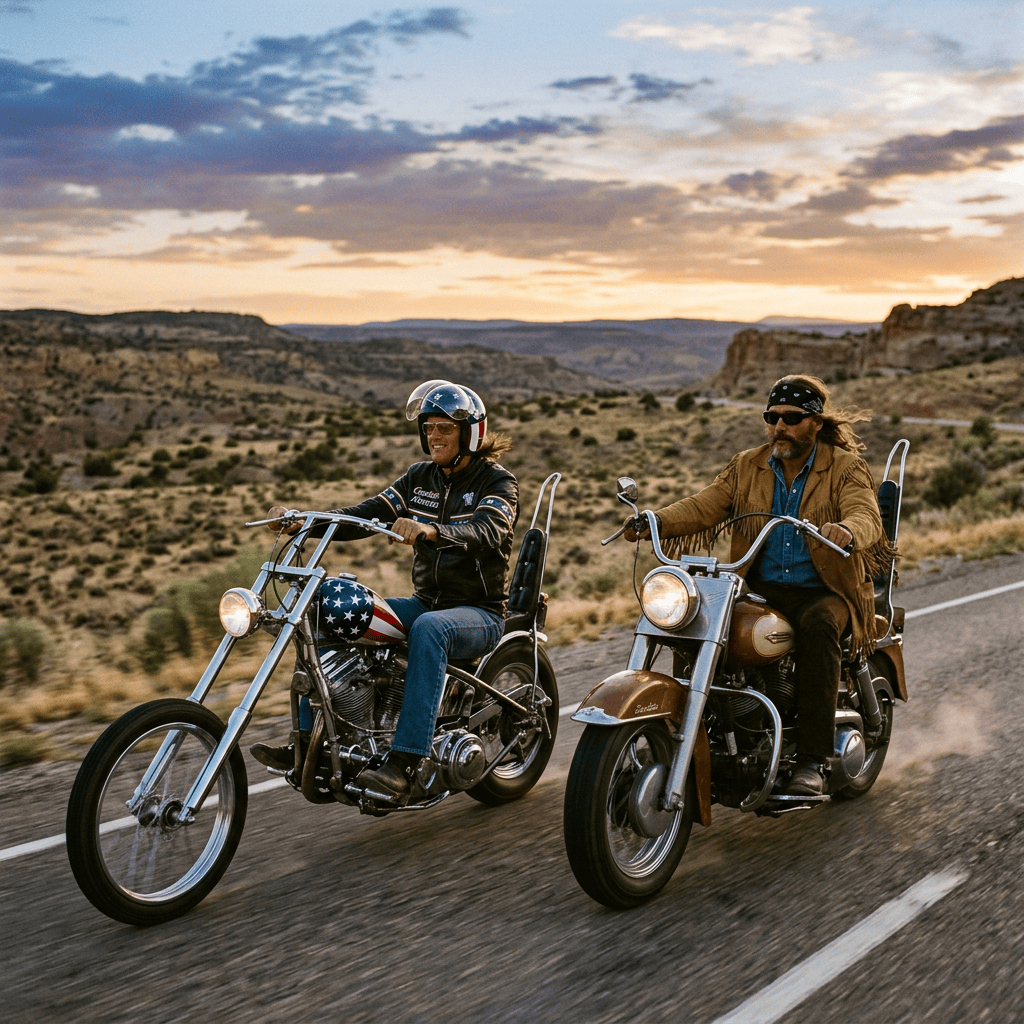
I refer to veteran actor and fledgling movie director Dennis Hopper’s ground breaking, hallucinogenic paean to the baby boom generation in ascendance, “Easy Rider,” released in the United States in July of 1969 after winning an award at the Cannes Film Festival for “best first work”. The movie is about two maverick, drug dealing, pot smoking, long-haired late 20-somethings, who set out on a picaresque motorcycle journey across late-60s America—an America, where in the words of Buffalo Springfield’s Stephen Stills, the battle lines had been drawn, between “mainstream” culture and the insurgent counterculture, the latter represented by the film’s two protagonists– the contemplative, gentle and soft spoken Wyatt (Peter Fonda), ironically nicknamed “Captain America”, and his volatile, quick to offend (and be offended) sidekick Billy (Hopper).
The film’s visceral grasp of the cultural Zeitgeist is still evident almost sixty years later. That said, it is best known today as the launching pad for the superstar career of a 32-year-old journeyman actor/director/writer named Jack Nicholson, who portrays the alcoholic civil rights lawyer (and the movie’s intended soothsayer) George Hanson. Nicholson’s breakthrough supporting turn notwithstanding, Fonda is the moral center of “Easy Rider,” which purports to be about the symbolically (and physically) fatal quest of Fonda’s “Captain America” character to find the pulsating heart of America itself.
In retrospect, the movie can also be seen as a yardstick for measuring how far from our counterculture conception of “freedom” we have strayed in the 21st century.
The message of “Easy Rider” is all about freedom, which Nicholson as Hanson articulates while sharing a joint over an open fire with Wyatt and Billy, explaining to them why they are meeting with such hostility from the locals. “Of course, don’t ever tell anybody that they’re not free, ’cause then they’re gonna get real busy killin’ and maimin’ to prove to you that they are. Oh, yeah, they’re gonna talk to you, and talk to you, and talk to you about individual freedom. But they see a free individual, it’s gonna scare ’em. You represent freedom to them, and they’re scared of that,” he says. Just to prove the point, Director Hopper has the Nicholson character beaten to death by the standard-issue rednecks in the next scene.
Echoing this sentiment is Wyatt’s more poignant observation after breaking bread with a rancher and his family. At one point Wyatt turns to the rancher and says “you’re doing your own thing in your own time. You should be proud.”
Almost sixty years on, freedom still scares people, but it’s the presumptive Wyatts and Billys who seem most fearful at the prospect of it. A 2023 Buckley Institute survey of college students found that almost half (46 percent) of students believe it is fine to shout down speakers with whom they disagree. That same 46 percent agree that opinions they find offensive should be reported to campus administrators, and 46 percent agree that students making offensive remarks should be subjected to sensitivity training. A 2024 Knight Foundation survey found that 64 percent of students want safe spaces to shield them from ideas they consider harmful versus only 15 percent who don’t.
Today, freedom has shifted shape in the dominant culture- from the freedom to be, in Wyatt’s words, your own person in your own time, to the freedom from being exposed to things we do not like, don’t agree with or don’t want to understand. In this social media-dominated era, you do not have to bash someone over the head with a baseball bat to rid yourself of a person whose ideas you dislike. You can just unfollow them. Or support cancelling them. Or, in what is becoming increasingly- and sadly- the case, you can threaten them and their families, cowing them into silence.
The irony is that “Easy Rider,” with its standard pieties about doing your own thing and being unapologetically who you are, still speaks to the people whose imagination it captured sixty years on. That’s because many of us still consider ourselves “easy riders”—mavericks who value freedom and push back against conventional values. In our own conception, it is always the sixties, and we are always speaking truth to power. It is a romantic, self-referential point of view. It is a myth we tell in order to connect with some former version of ourselves- one that is well past its “sell-by” date.
Would-be boomer iconoclasts can luxuriate in other auteur-driven films released in the early to mid ‘70s like “Three Days of the Condor”, “The Parallax View” and “Rollerball”, in which desperate, atomized individuals wage what is invariably a vain yet valiant struggle against “the system”, or what we used to call “The Man”. These movies still resonate, because they flatter us into thinking we are the mavericks on the screen, when in fact what most of us have become is what the conceit of these films most fear. We see ourselves as the lone, superstar challenger of the conformist, pacified society in “Rollerball”, James Caan’s indomitable Jonathan E. When in fact we more likely resemble the corporatist/statist overlord portrayed by a glowering John Houseman.
Prior to Easy Rider’s explosive final scene, Wyatt provides an epitaph for their journey, the movie, and, with the benefit of hindsight, my generation. Before heading off to a fiery death that was foreshadowed earlier in the film, Wyatt turns to Billy and speaks the line that spawned decades of debate: “we blew it.” Billy has no idea what he is talking about, and nor did we at the time sitting in the darkness of that movie theater. But with the benefit of hindsight, we get the picture.
Fonda and Hopper (above) riding off into an uncertain future for them, and for us.
NOTE: “On Second Thought” is a blog that takes a second look at culture, history and society that challenges conventional wisdom and considers cultural landmarks, events and people from a different perspective.


Leave a Reply